
Safety of medicines administered on an ongoing, long-term basis as a preventive measure is always a concern. A team of scientists in India with a collaborator from Switzerland has evaluated the efficacy, tolerability, and safety of two such drugs- albendazole (ABZ) and diethylcarbamazine (DEC) that are used for mass drug administration (MDA) for populations susceptible to Lymphatic Filariasis (LF) caused by roundworms.
The team led by Dr. Kshirsagar of Seth GS Medical College and KEM Hospital, Mumbai compared the efficacy and safety of a 3-year treatment program of a single annual dose of DEC + ABZ with a single annual dose of DEC in subjects from Kurzadi and Selukate villages, Wardha, Maharashtra, India.
In 2000, the Global Program to Eliminate LF (GPELF) was launched to limit disease transmission by reducing microfilaria (Mf or immature larvae) using drugs. Mf or immature larvae are responsible for transmission while the macrofilaria or the adult worm results in disease.
This group studied the safety and micro (Mf) and macro filarial action of single-dose diethylcarbamazine (DEC) and DEC + albendazole (ABZ) in Wardha in the year 2000 and found no difference between the two prevention protocols. They further continued this study with annual rounds of DEC and DEC + ABZ to assess the efficacy and safety of these drugs. Using standard assays, they confirmed a decline in Mf positivity in the subject population. The study also showed ABZ + DEC and DEC drugs as being well tolerated although supplementation of DEC with ABZ did not show any advantage over only DEC.
Dr. Kshirsagar and co-workers suggest,
“this study is important for monitoring and evaluation of elimination program since efforts are being made to develop macrofilaricidal drug by Drugs for Neglected Diseases initiative (DNDi).”
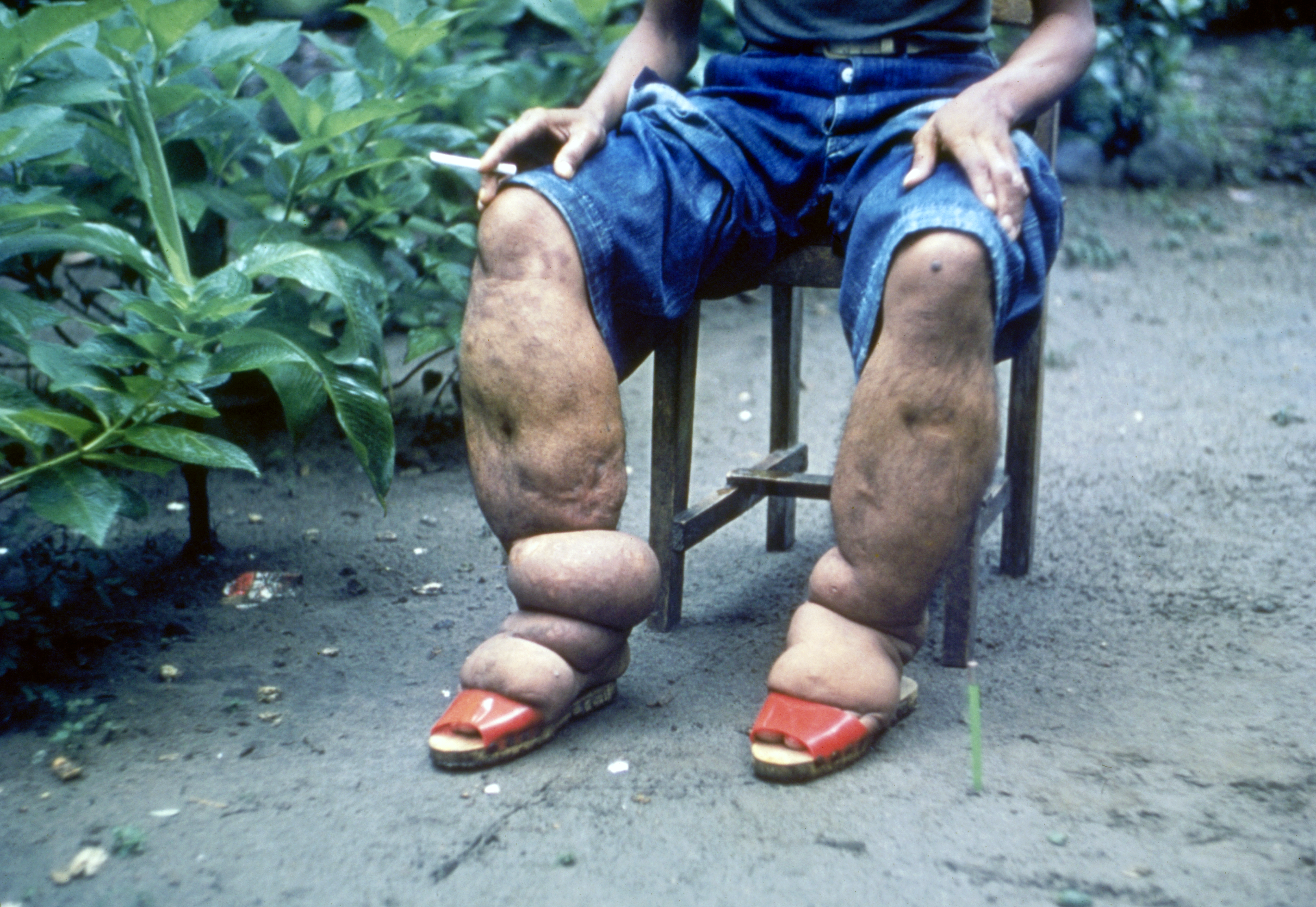
Mosquitoes in developing countries play havoc with public health, transmitting disease-causing organisms. LF commonly known as Elephantiasis is another disease spread by mosquitoes carrying the infectious roundworm and it affects millions of people across 52 countries. Along with vector control measures, World Health Organization (WHO) applies another strategy to combat these diseases which is preventive chemotherapy or mass drug administration (MDA) to vulnerable populations.
“Authors have performed a well thought of study that was carefully designed after applying several inclusion/exclusion criteria as well as ethical implications. The interpretation with regards to the beneficial effects of ABZ, DEC when given alone compared to when given in combination remains inconclusive and may require proof of principal by carrying out similar studies on larger cohort size. Overall, study finds interest in the context of disease burden and its prevention in the Indian scenario”,
Dr. Naresh Arora, Project Scientist, DBT-CoE, Jamia Hamdard University. He is not connected with the study.
The WHO fact sheet, October 2017 states that since the launch of GPEFL (2000), more than 6 billion treatments have been provided to stop the spread of Lymphatic Filariasis. With the effective application of WHO’s strategy of MDA, about 500 million people no longer require preventive chemotherapy.
The team comprised of NA Kshirsagar, NJ Gogtay, VS Kadam, PA Thakur, A Gupta, and DD Rajgor of Seth GS Medical College and KEM Hospital, Mumbai, BS Garg, PR Deshmukh, and NS Ingole from Mahatma Gandhi Institute of Medical Sciences, Wardha and JK Lazdins-Helds, World Health Organization (WHO), Special Program for Research and Training in Tropical Diseases, Switzerland. This study was reported in Parasitology Research Journal, August 2017 issue and the work was carried out with financial support from the UNDP/World Bank/WHO Special Program for Research and Training in Tropical Diseases (TDR).